Our Antidisciplinary Mandate
Neri Oxman's Krebs Cycle of Creativity arranges Science, Engineering, Design, and Art as positions on a single continuous loop, each turning the output of the previous into a new form. As the Krebs cycle in biology turns molecules into the energy a cell needs to live, this cycle turns one kind of knowledge into the next. In Oxman's diagram, science and design sit opposite each other on the circle. Unlike the adjacent pairs, their relationship is mediated rather than direct. Building the lens that connects them — fusing design and science to advance both — is one of the things SDS exists to do.
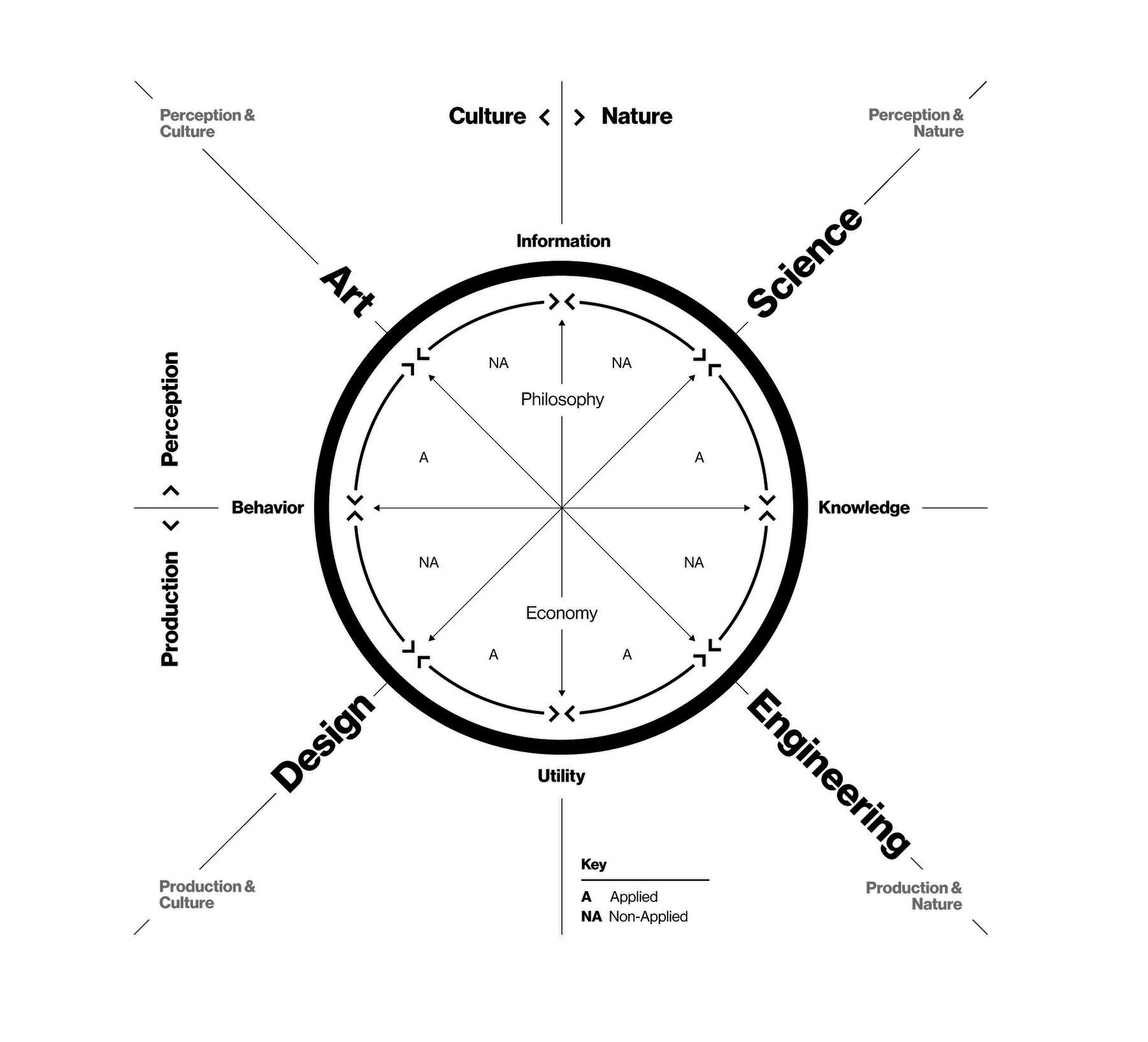
“We engage these four domains not by training specialists in each, but by cultivating the capacity to traverse between and transcend them. With sufficient energy — achieved through excellence and deep integration — practitioners can leap directly between domains. Each realm can incite revolution within another. We seek to redefine expertise itself.”— From the SDS Charter
A Graduate Program Inside a Research Center
SDS is a graduate school; the Henkaku Center is its research home. The two were built together and operate as one community.
School of Design & Science (SDS)
SDS operates as the academic arm of the Henkaku Center. It is a degree-granting institution, providing structured Master's and PhD programs that combine rigorous academic training with hands-on research experience. Students in SDS programs work directly with Henkaku Center faculty and participate in ongoing research projects.
Henkaku Center
The Henkaku Center is the research laboratory. It conducts antidisciplinary research that bridges technology, design, governance, and society; attracts external funding through grants, industry partnerships, and philanthropy; hosts visiting researchers; and produces impact through prototypes, publications, frameworks, and experimental systems.
henkaku.center →What we're working on
Students at SDS work alongside Henkaku Center researchers on active projects, with external collaborators that include MIT, the Royal Government of Bhutan, Sozo Ventures, and the Japan AI Safety Institute.
AI Education
Curricula on two pillars: teaching students to work with AI, and teaching with AI as the medium through which they build conceptual understanding. A shift from problem-solving to problem-posing, and from assessing answers to assessing judgment.
AI Safety Workshop
Building communities focused on responsible AI development, with the backing of the Japan AI Safety Institute (J-AISI). Bridges international AI safety communities with Japan's network through sustained engagement.
Artificial Life
Exploring the essence of “life” by constructing living systems. The work uses minimal fitness criteria that generate diverse results through exploration — much as natural evolution did through survival.
Dabtong House
Joint projects with DHI and GovTech of Bhutan — satellite-imagery research and voxel-based construction with MIT and Chiba Tech material scientists. A scholarship program has brought six Bhutanese students to Chiba Tech.
Neurodiversity & Connected Learning
Designing education that honors each learner's unique mind and fosters individual growth, developed in partnership with the Connected Learning Alliance.
Probabilistic Computing
A Henkaku Center–MIT collaboration advancing smarter, safer AI using probabilistic programming — embracing uncertainty as a feature of intelligence rather than something to engineer away.
Radical Transformation Award
A 10M-yen prize recognizing transformative individuals advancing human flourishing — designed to surface and celebrate the kind of leverage SDS exists to produce.
Sustainable Robotics Construction
Developing voxel-based, sustainable robotic construction methods in collaboration with MIT, with applications from Bhutan to Japan.
Tea Project
Cultivating humane technology and community through tea philosophy and the 青灯亭 tea house. A space where tradition meets innovation — technological wisdom that begins with a simple cup of tea.
Entrepreneurship with Sozo Ventures
A course and ongoing initiative powered by Sozo Ventures that connects students with a global network of innovators, mentors, and startup founders. It also explores how AI is reshaping the economics of starting something, and what that means for Japanese entrepreneurs specifically.
AI Tokens & Committee
Through partnerships with Microsoft and Anthropic, the university funds projects with Claude credits and subscriptions rather than regular grants — putting real AI capacity in researchers' hands at the scale serious research demands.
Want to do research at SDS?
Our Master's and PhD programs are research-led from day one.